Precision first.
The first wavefront carries localization cues and the fundamental character of the instrument or voice.
MBL International uses certain cookies and similar technologies (collectively "cookies") to provide our services to you reliably and securely. These cookies are set by default when you visit our websites and do not require consent. With your consent, we and our partners use additional cookies to improve the performance of our websites, to provide you with a personalised browsing experience and to provide interesting content and advertising on the internet. To do this, we collect information about your devices, your usage patterns on our website and your interaction with our advertisements. By selecting "Accept", you consent to our use of additional cookies and agree that we may share the information collected with our partners, some of which may be located outside the EU, for example in the USA. The US is a country that does not provide an adequate level of protection for personal data - as defined by the EU Regulation 2016/679 ("GDPR"). You can revoke or adjust your consent at any time by accessing the "Privacy settings" page.
MBL International uses certain cookies and similar technologies (collectively "cookies") to provide our services to you reliably and securely. These cookies are set by default when you visit our websites and do not require consent. With your consent, we and our partners use additional cookies to improve the performance of our websites, to provide you with a personalised browsing experience and to provide interesting content and advertising on the internet. To do this, we collect information about your devices, your usage patterns on our website and your interaction with our advertisements. By selecting "Accept", you consent to our use of additional cookies and agree that we may share the information collected with our partners, some of which may be located outside the EU, for example in the USA. The US is a country that does not provide an adequate level of protection for personal data - as defined by the EU Regulation 2016/679 ("GDPR"). You can revoke or adjust your consent at any time by accessing the "Privacy settings" page.
MBL International uses certain cookies and similar technologies (collectively "cookies") to provide our services to you reliably and securely. These cookies are set by default when you visit our websites and do not require consent. With your consent, we and our partners use additional cookies to improve the performance of our websites, to provide you with a personalised browsing experience and to provide interesting content and advertising on the internet. To do this, we collect information about your devices, your usage patterns on our website and your interaction with our advertisements. By selecting "Accept", you consent to our use of additional cookies and agree that we may share the information collected with our partners, some of which may be located outside the EU, for example in the USA. The US is a country that does not provide an adequate level of protection for personal data - as defined by the EU Regulation 2016/679 ("GDPR"). You can revoke or adjust your consent at any time by accessing the "Privacy settings" page.
MBL International uses certain cookies and similar technologies (collectively "cookies") to provide our services to you reliably and securely. These cookies are set by default when you visit our websites and do not require consent. With your consent, we and our partners use additional cookies to improve the performance of our websites, to provide you with a personalised browsing experience and to provide interesting content and advertising on the internet. To do this, we collect information about your devices, your usage patterns on our website and your interaction with our advertisements. By selecting "Accept", you consent to our use of additional cookies and agree that we may share the information collected with our partners, some of which may be located outside the EU, for example in the USA. The US is a country that does not provide an adequate level of protection for personal data - as defined by the EU Regulation 2016/679 ("GDPR"). You can revoke or adjust your consent at any time by accessing the "Privacy settings" page.
MBL Technology
The Radialstrahler principle begins with a simple idea: natural music is not projected through a narrow beam. It expands into space. MBL's proprietary radial drivers are engineered to recreate that behavior with an omnidirectional, room-filling sound field.

The Radialstrahler Principle
Conventional drivers primarily project sound forward. The Radialstrahler uses dedicated radial drivers to distribute acoustic energy concentrically around the loudspeaker, creating the direct and reflected sound components that make listening feel more natural.
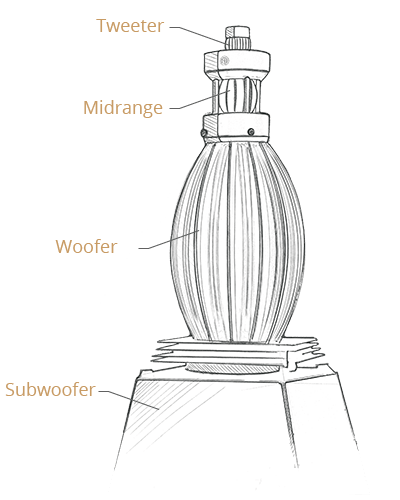
01 · Architecture
The classic MBL 101 follows a familiar multi-way logic: separate drivers reproduce treble, midrange, bass and sub-bass. The difference lies in how the radial drivers launch sound into the room rather than concentrating it on a single forward axis.
The objective is not simply wider dispersion. It is a more convincing balance between direct sound and the reflections created by the listening room itself.
The first wavefront carries localization cues and the fundamental character of the instrument or voice.
Walls, ceiling and floor contribute early reflections that enrich timbre and convey a believable sense of space.
When direct and indirect energy arrive in a convincing proportion, the loudspeaker becomes less obvious and the musical event becomes more present.
Inside the Driver
At the heart of the Radialstrahler chassis are petal-like lamellae arranged around a central axis. Their controlled movement transforms the electrical signal into a pulsating, omnidirectional acoustic field.
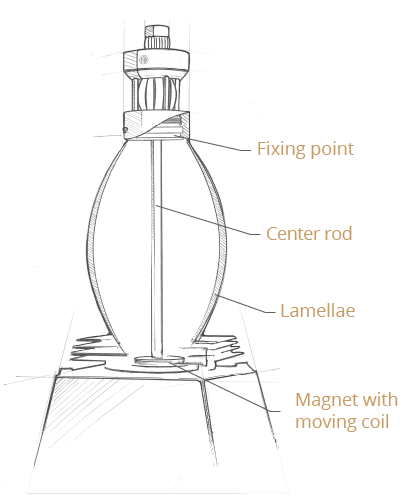 Radialstrahler anatomy
 Radial movement
Each lamella is permanently fixed at its upper end, creating a defined mechanical reference point.
The lower end connects to the voice-coil assembly and moves within the magnetic gap as the music signal changes.
The collective flexing action produces a pulsating surface that sends sound outward around the full circumference of the driver.
Look to Science
The MBL technology story connects loudspeaker design with the physics of hearing: how the ear localizes events, how the room contributes spatial information and why relaxed listening depends on more than a narrowly focused direct signal.

Performance in a laboratory is only part of the story. In a real room, transducer behavior and acoustics interact continuously with the listener.

The auditory system can localize sound extremely quickly by analyzing tiny timing and pressure differences between the ears.

When playback supplies natural spatial cues, the brain has less missing information to reconstruct and can focus more freely on the musical experience.

Omnidirectional Advantages
Freeing the midrange and tweeter from a conventional enclosure removes several familiar sources of coloration while the radial radiation pattern changes how the loudspeaker interacts with the room.
No conventional mid/tweeter cabinet means no cabinet resonance in those ranges and fewer baffle-related reflections or edge-diffraction effects.
Energy is distributed around the room in a way that more closely resembles the behavior of acoustic instruments in a real space.
The stereo image can feel airy, spacious and three-dimensional because the loudspeakers themselves become less dominant as apparent sound sources.
The listening experience is designed to remain convincing beyond a single tightly restricted sweet spot.
The Spatial Listening Experience
With a natural sound source, the direct wave reaches the listener first. Shortly afterward, early reflections arrive from surrounding surfaces. Together they provide localization, tonal character and information about the scale of the acoustic space.
Too little reflected energy can make reproduction feel sterile. Too much, or reflections that persist for too long, blur the musical event. The listening experience depends on balance.
Early reflections · roughly 20–50 ms later

The Importance of Indirect Sound
Concert halls are designed around carefully controlled reflections because those reflections are fundamental to how listeners perceive scale, timbre and ambience. A high-fidelity system faces the same acoustic reality in the home.
For MBL, reproducing music naturally means radiating energy not only forward but also sideways, backward, upward and downward so that the listening room can contribute a believable sequence of direct sound, early reflections and reverberant decay.
The Limits of Conventional Loudspeakers
As radiating surfaces become large relative to wavelength, conventional drivers increasingly concentrate energy along their forward axis. In a multi-way design, this directional behavior changes as frequency rises and different drivers take over.
The result can be less indirect energy at higher frequencies and a listening balance that changes more noticeably as the listener moves away from the central axis.


Enjoying Music Everywhere
MBL's omnidirectional approach is designed so that tonal balance and spatial impression remain stable across a broader seating area. The goal is simple: live with the loudspeakers, move through the room and keep the music convincing.